Drum-to-disc: what has to match
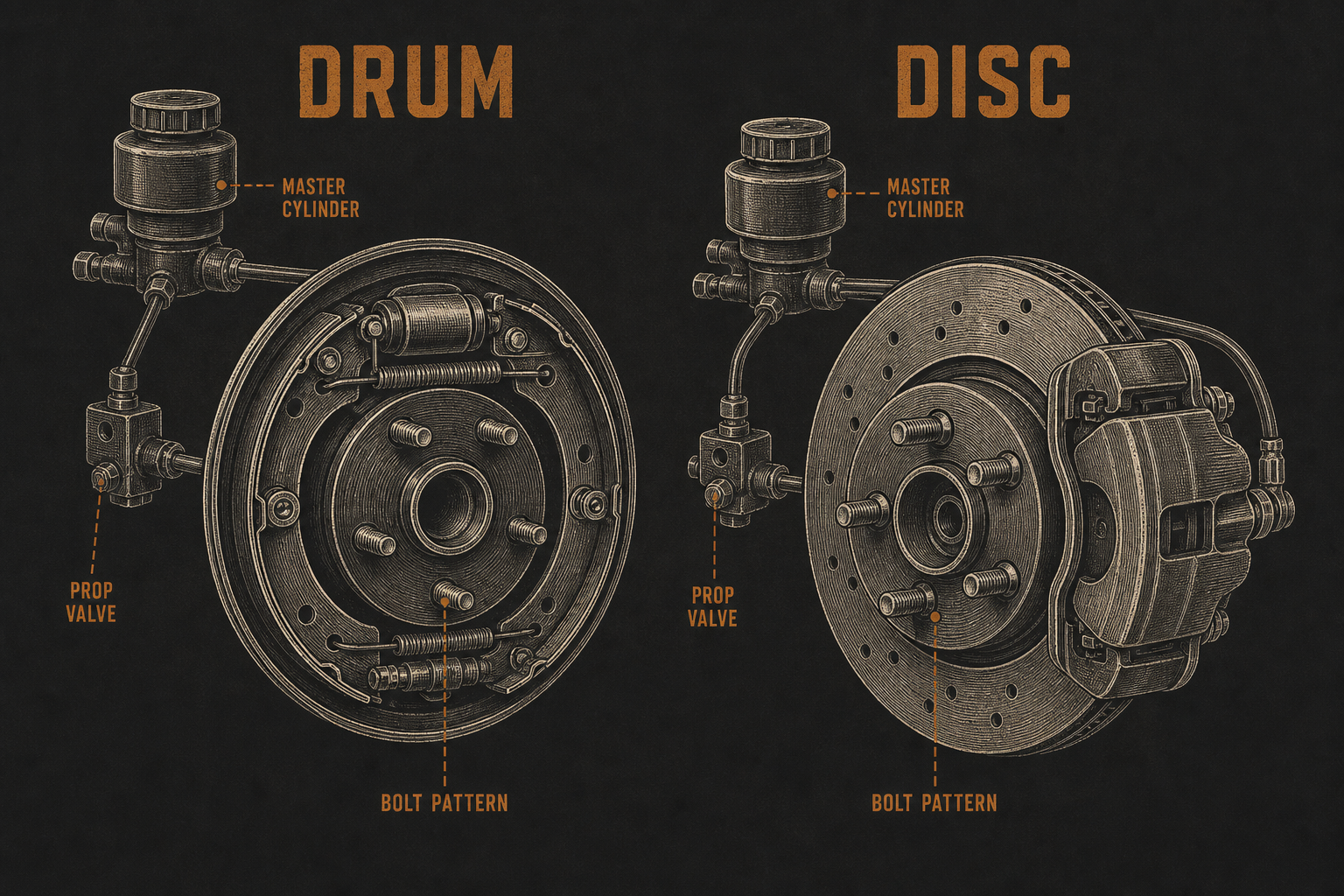
A disc conversion is not “calipers and a rotor.” The hydraulic system is a matched circuit. Change one end and the bias moves. Do this in a driveway if you want. Do not pretend the box-kit photo is the whole job.
1. Spindle and knuckle
First-gen Camaro, Nova, Chevelle, and the A / F / X cousins do not all share the same spindle. Disc spindles have a different caliper-bracket register. Cheap kits that hang a caliper on a drum spindle are how you get pad taper and a collapsed hose. Buy the spindle the kit was designed for, or a known factory disc spindle for that chassis, and check ball-joint taper and steering-arm bolt pattern before you grease it.
2. Bolt pattern
Chevy passenger cars are usually 5 × 4.75 in (5 × 120.65 mm). Ford is often 5 × 4.5. Mopar mixes 5 × 4.5 and 5 × 4.75 by year and body. Swap a Camaro disc onto a Dart and the wheels may not even go on. Measure the pattern. Do not guess from the year on the fender tag.
3. Master cylinder
Drum masters are a smaller bore, often with residual check valves in the drum ports, and a different pushrod length. A disc master is typically a larger-bore dual-reservoir unit without a 10-lb residual on the disc circuit. Leave a drum residual in a disc line and the pads drag. Leave a disc master on four-wheel drums and you get a long pedal.
4. Proportioning
The factory combination valve on a disc / drum car is not the same chunk of brass as a four-drum distribution block. Aftermarket adjustable props go after the master, on the rear circuit. Set them on a loose surface or with a pressure gauge: bring it in until the rear wants to lock, then back off. That is the street method. We do not publish a “two turns from the bottom” number. Kits, line sizes, and tire compounds differ.
5. Parking brake and hoses
Many kits use a rear disc with a drum-in-hat or a caliper lever. The cable geometry has to pull evenly. A cable that worked on shoes will not automatically work on a caliper lever.
New flex hoses. Flush DOT 3 or DOT 4 per the book, not whatever was on sale. Silicone DOT 5 does not mix with glycol. Do not mix them.
Bleed the longest line first, or use the sequence in the manual. Residual air in an adjustable prop will make you chase a soft pedal for a day.
Road check
Eighty km easy. Re-torque the wheels. Check for hose bulge. Then a controlled stop from 60 km/h in a safe lot. If the rear comes around, the prop is too far open. If the fronts lock and the rears do nothing, you went the other way.
This is customization you can own. It is not a Saturday if you ignore the hydraulics.